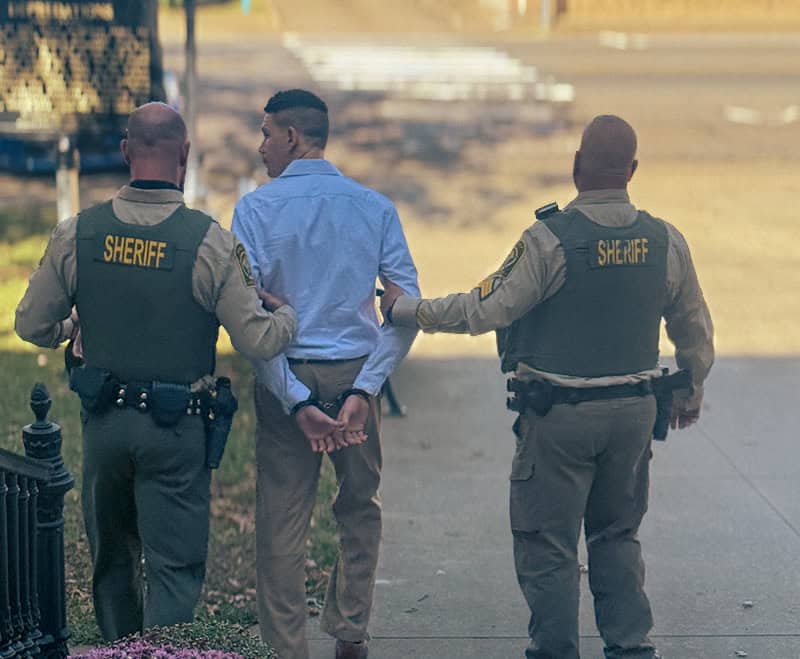
CLARKSVILLE, Ark. — A Johnson County jury found Colton Taylor Contant guilty of first-degree murder Tuesday and sentenced him to life in prison in the shooting death of a Clarksville man who had gone to Coal Hill City Park for an afternoon walk on Veterans Day of 2025. The jury added 15 years on top of the life sentence under a firearm enhancement that can apply if a gun is used in the commission of the crime.
The verdict came shortly after noon on the second day of Contant’s trial. Jurors later imposed the maximum punishment on both the murder charge and the firearm enhancement.
Contant, 26, remained mostly expressionless as Circuit Judge Dunham pronounced the sentence Tuesday afternoon. After the guilty verdict was read, however, Contant turned toward his mother seated in the courtroom and mouthed, “I love you.” A short time later, he appeared to tell her, “It’s okay.”
The case centered on the Nov. 11, 2025, shooting death of Kenneth E. Michaels, 68, of Clarksville, who was found by police officers deceased beside his vehicle at the park.
The two-day trial included testimony from investigators and forensic experts who reconstructed the shooting, tied Contant to Michaels’ vehicle and connected the weapon recovered from his residence to the case. The defense never presented an affirmative defense or called any witnesses of its own, instead arguing that prosecutors had failed to prove Contant acted with the purpose required for first-degree murder.
Monday’s testimony provided a detailed account of the shooting and the investigation that followed.
Johnson County dispatch received a 911 call shortly after 3:30 p.m. on Nov. 11 from someone reporting gunshots at Coal Hill City Park. The caller described seeing a man on the ground and another man running north from the park.
Coal Hill Police Officer Jackson Pyron arrived minutes later and found Michaels dead beside his red Ford passenger car. Testimony described Michaels lying face down in the parking lot, with his feet still inside the car.
Arkansas State Police Special Agent Erick Riggs testified about an interview with Contant following his arrest.
According to Riggs, Contant described approaching Michaels’ vehicle from the passenger side and opening the passenger door while Michaels was opening the driver’s door.
Contant said Michaels spoke to him and appeared to be getting something from the vehicle. He claimed he became nervous when Michaels flinched. Then Contant fire his gun.
Contant described firing two shots, one striking Michaels in the chest and another in the back as Michaels fell. He identified the locations of the shots during the interview and did not deny shooting Michaels, neither to investigators nor at any point throughout the trial.
The account placed Contant on the passenger side of the vehicle, firing across the interior toward Michaels.
Fingerprint evidence also tied Contant to that side of the car. Investigators recovered prints near the passenger door handle and window that were matched to Contant.
Additional evidence connected him to the shooting after he fled the park.
Investigators testified that Contant returned to his nearby residence, showered and changed clothes. They later recovered a revolver wrapped inside the black leather jacket he had worn, along with ammunition. The spent casings had been removed from the revolver, and live rounds had been loaded into it.
The prosecution’s remaining testimony Tuesday took less than an hour.
Arkansas State Medical Examiner Dr. Adam Craig told jurors that Michaels suffered two gunshot wounds, one entering the right upper chest and the other the right upper back. Both bullets struck the heart and aorta.
The state also called a firearms expert and a fingerprint analyst, both of whom testified that the evidence traced back to Contant.
The state rested by 10 a.m. on Tuesday, and the defense called no witnesses.
Following unsuccessful motions for a directed verdict, defense attorney Theodis N. Thompson Jr. requested a brief recess to discuss with Contant whether he wanted to testify.
Contant had been advised of his right to take the stand. When court resumed, he declined.
Closing arguments began shortly afterward.
Prosecuting Attorney Jeff Phillips acknowledged that the evidence had been presented quickly, but told jurors the short trial did not diminish the seriousness of the killing.
“The case moved along at a brisk pace, but this case is extremely serious,” Phillips said.
Phillips described the shooting as a random act of violence against a man who had simply gone to the park for a walk.
“It should have been a nice, fall day,” Phillips said. “He had every right to expect that he would be safe at that park in a small town in the mid-afternoon. But he wasn’t safe.”
Phillips acknowledged that prosecutors could not explain Contant’s motive, but argued they did not have to. The question was whether Contant acted with the purpose of causing Michaels’ death.
He challenged Contant’s explanation to investigators that Michaels flinched, prompting him to fire.
“That makes no sense whatsoever,” Phillips told jurors. “When did that happen? When he was sitting in his own car and a stranger comes up and opened his door? Who wouldn’t?”
Phillips also pointed to the medical examiner’s testimony, arguing that the second wound was consistent with Michaels attempting to avoid another shot.
Thompson focused his closing argument on whether prosecutors had proven purpose beyond a reasonable doubt.
“Michaels went to the park to have a walk,” Thompson said. “The question isn’t whether something terrible happened to him, because it did.”
He argued that there had been no previous relationship between the men, no threats, no argument and no evidence of planning before the encounter.
Those circumstances, he told jurors, raised questions about whether Contant had acted with the deliberate purpose required for first-degree murder.
“I say they do not,” Thompson said.
In rebuttal, prosecutor Heather Patton returned to what Contant had done at the park and afterward.
She described him wearing a black leather jacket and a yellow-and-black gaiter, armed with a loaded revolver in the middle of the afternoon.
Michaels, she argued, was already trying to leave when Contant approached.
“He was in his car — he was leaving,” Patton said. “He was trying to get out of there and he couldn’t get out of there quickly enough.”
Patton pointed to Contant’s decision to approach Michaels’ vehicle, open the door and fire twice, followed by his actions after returning home.
“When you follow a target, when you go to their car, when you open that door, shoot twice, you are intending to kill him,” Patton said. “You are acting with purpose.”
During the sentencing phase, prosecutors called Michaels’ brother, Chris Michaels, who spoke about the man his family had lost.
He described his brother as someone who attended church, enjoyed road trips and loved walking trails.
Kenneth Michaels had broken his ankle a few months before his death and had been unable to walk as much as he wanted. The trail at Coal Hill City Park was flat and paved, making it an easier place for him to walk as he recovered.
It was that simple activity that brought him to the park on the afternoon he was killed.
The defense called no witnesses during sentencing, and Contant again did not testify.
Phillips asked jurors to impose the maximum sentence, arguing that the random nature of the killing raised concerns about what Contant might do in the future.
“He gave Kenneth Michaels death,” Phillips said. “The most you can give him is life…. And it’s still less than what he gave the victim.”
Thompson asked jurors for a lesser sentence.
After approximately an hour of deliberations, the jury returned with a life sentence for first-degree murder and an additional 15 years for the firearm enhancement.
Dunham formally pronounced the sentence Tuesday afternoon and advised Contant that he has 30 days following entry of the sentencing order to pursue an appeal.